Wednesday, April 24, 2013

Selecting Backlog Items By Cost of Delay

Selecting the right items for an agile project to work on next is vital to ensure your team is delivering the maximum value possible to the business. Rather than "MoSCoW" (see recent post) or similar prioritisation schemes, +David Anderson's Kanban book recommends using the opportunity-cost of delay as the way to decide which items to pull next (or which items to put into the next sprint if you're using Scrum). He suggests 4 archetypes for categorising what the cost of delay might look like, when the impact (opportunity cost) is plotted against the time of release:


Expedite items have a high and immediate cost of delay. They should be started at once and given priority over other items. Fixed date items have a high cost of delay once a threshold is passed. They should be started before there is a significant risk this date will not be met. Standard items' cost of delay follows a fairly shallow S-curve, in other words, there is no reason to expedite them - they should be handled normally. Intangible items apparently have no immediate cost of delay, though it is expected to rise at some more distant point in the future. Such items are useful background tasks to be handled when there are no more urgent tasks.

At a recent Kanban Masterclass I attended, David introduced an example to demonstrate the difference between Fixed Date Items and Standard Items:
A hotel/resort site wishes to offer two special promotions: one for the Spring/Easter holiday; one for Valentine's Day. Because people tend to book much later for Valentine's Day, the opportunity-cost of delay is likely to be much "steeper" - more like the Fixed Date case, compared to a more "Standard" shape for the other promotion.

This led to consideration of what the revenue projections for different release dates might be in these 2 cases, so I undertook to produce some sample data for discussion. Here they are.


The graph above shows the imagined additional sales generated by launching the Easter promotion on the dates shown. There's no point in launching before Christmas and New Year are over (zero cost of delay), so the first release date is January 1st. There's an initial bump when the first ads go out, then a growth in revenue, and in this case a rapid drop off when it is anticipated all places will be sold. Later releases follow a similar pattern but after 5 or 6 weeks' delay the cost in lost sales becomes much higher as sales go to the competition or simply have insufficient time to close.


The graph above plots the loss of revenue of the early February release (5 weeks delay) compared to 1st January release. Sales are always behind - even after the slight recovery in the period after the January release has sold-out.
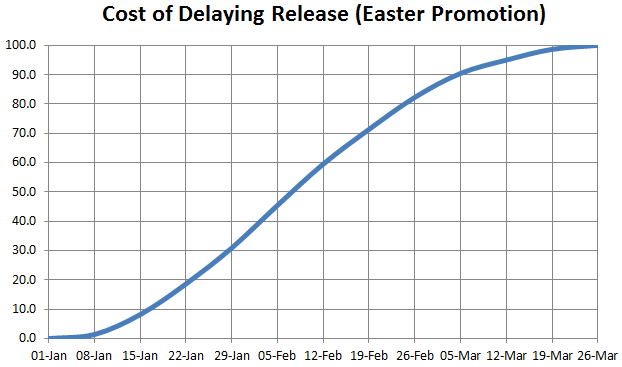

Taking all the potential release dates and plotting the opportunity-cost for each delay produces the graph above - an S-curve showing little impact initially, rising more rapidly after the first couple of weeks.

Let's compare that with the simulated data for the Valentine's promotion.


In this case we are expecting nearly all the sales to be made in the last couple of weeks before the event. It really doesn't help to launch early because people won't book early any way!


So plotting the cost of delay in this case we get a curve which is much closer to the archetypal step function of the Fixed Date items. If there are items with higher opportunity cost of delay early on in the year, it is more beneficial to do these items, provided we don't miss the late January release for the Valentine's promotion, i.e. the point where the curve hits the "hockey stick" upwards.

Hopefully these examples help the understanding of the concept of using cost of delay for deciding which item an agile team should do next. Let us know if you have any real data examples to demonstrate this concept. I'd be most interested to hear about them.

Monday, April 22, 2013

MoSCoW - is it a sensible way to prioritize requirements?

Back in the mists of time (some time in the last century) DSDM came up with a neat acronym for classifying the importance of requirements, MoSCoW - meaning a requirement was one of:
  • Must-Have
  • Should-Have
  • Could-Have
  • Won't Have (even if you Want it!)
The problem with this scheme has always been getting stakeholders to specify their requirements as anything other than Must-Have and Project Managers to resource their projects so that there's anything other than barely enough time for the mandatory requirements. Just like my old boarding school - if it wasn't compulsory it was forbidden. Many agile practitioners have concluded that schemes like this which give user stories a priority value or category, are not worth the effort - just get the product owner to identify the next most important stories and we'll prioritize the other requirements later. I sympathise with that view but on a previous project I needed a way to introduce the idea of a "scope range" for each release of the software, and to do that I redefined the meanings of the MoSCoW categories.

Firstly Must and Won't:

Must-have (this release): If this functionality is not available by the release date, the release will be delayed.
Won't-have (this release): If all the other functionality is complete before the release date, we'll release early rather than start this work.

Should-have and Could-have both mean they will be attempted for the release if there's time. The difference between them is whether our forecasting predicts that it is more or less likely that they will make it. Thus:

Should-have (this release): Our forecasting shows a greater than 50% probability that the functionality will be included.
Could-have (this release): Our forecasting shows a less than 50% probability that the functionality will be included.

I felt this was a stepping stone for the client, to move away from deterministic and towards probabilistic planning. The main problem with the approach was that I was re-using a scheme that already had a publicly available definition and so in a large organisation there was no guarantee people would be using the definitions I had introduced.

A better approach now is to look to schemes based on the cost of delay of requirements. This again emphasises the probabilistic nature of forecasting and uses flow data from the process to optimise costs.

Friday, April 19, 2013

"What's your favourite technique for estimating stories in Scrum?"

My number one favourite? Not estimating them at all! 

Instead, ensure stories do not exceed an agreed size that ensures they fit easily within a sprint (ok - I agree that's estimating, but it's much simpler estimating than tee-shirt sizes (S, M. L or/and too big) or points (1, 2, 3, 5, 8,  and too big). Then spend the time you've saved estimating the size of stories on estimating the number of stories in the various epics in your product backlog. Measure velocity in stories not points (or use only two sizes: 1 point and too big) and forecast the completion of epics and minimum-marketable-features based on the throughput of stories (velocity) and the number of stories. 

As well as saving a ton of time, it turns out your forecasting will be just as accurate as if you'd spent ages agonizing over each story! See for example +Vasco Duarte's blog about the evidence for improved forecasts from this approach.

The key question - as +Neil Killick points out in his recent "People Need Estimates" - is what problem are we trying to solve with our estimating? 

I was working with a team recently who were concerned that they had missed their forecast for the second sprint in a row. The retrospective meeting came up with several suggestions about how they could improve their forecast for the next sprint. I asked the team whether there was anyone (outside the team themselves) who was interested or concerned about their forecasting ability. The last few sprints were running at a throughput that was over double the average for the previous year. If the team continued to focus on the improvements they were making, the business could easily adjust to this higher efficiency. The business did not need (or probably believe) the over-optimistic forecasts that the team were making. Shown the evidence of actually completed work, the business will adjust to the new opportunities the improvements open up.

Wednesday, April 17, 2013

There are 6 general practices of Kanban... and I'm happy with that!

There are 6 general practices of Kanban, and in spite of my preference for groups of 3 (see "There are 3 ... Principles of Kanban"), I'm really happy with that. (I guess 7 would have a nice golden ring to it... but now I am being silly.)

The core practices are:
  1. Visualize
  2. Limit Work-in-Progress
  3. Manage Flow
  4. Make Process Policies Explicit
  5. Implement feedback mechanisms
  6. Improve Collaboratively, Evolve Experimentally (using models & the scientific method)
Nevertheless I've found it useful to start a team off by emphasising three of these (no really):
  1. Visualize 
  2. Limit Work-in-Progress
  3. Improve
Before we can manage the flow we need to see it, and so getting a Kanban board with items moving across it really is the first step. Limiting work in progress is the essence of Lean and fundamental to all agile processes. Surprisingly to most teams, it nearly always brings an immediate impact in increased throughput and reduced lead time. And finally, as the foundational principles tell us, continuous improvement is the whole point. Let's start improving from day one.

Tuesday, April 16, 2013

There are 3, no make that 4... no really, shouldn't it be 3 Principles of Kanban?

+David Anderson first formulated the Foundational Principles of Kanban a few years ago:
  1. Start with what you do now
  2. Agree to pursue incremental, evolutionary change
  3. Respect the current process, roles, responsibilities & titles
I like that. It makes clear that Kanban is about changing your process (it isn't a process) and also that it's about changing your process in an evolutionary way - step by step, with a viable generation after each significant change. There's no known destination to the ideal, forever-great process, that we can produce a plan for getting to. Unlike the old farmer who replied to a request for directions with "You can't get there from here!", we have to get there from here, so let's start here.

I also like it because there's three! So much easier to remember.

But wait there's more. Recently the principles have been updated and there are now four. I'm sure someone will tell me when and by whom it was added, but I confess I don't know. I just know the fourth one's arrived. Even Wikipedia (2013-04-16) knows it, so it must  be true! So here are the four:
  1. Start with what you do now
  2. Agree to pursue incremental, evolutionary change
  3. Initially, respect current roles, responsibilities & job titles
  4. Encourage acts of leadership at all levels from individual contributor to senior management
Yes number four's a good one. It should definitely be there. But do we really need four? Three is much easier to remember, quicker to share, and - when two of the principles say almost the same thing - three could be a potential improvement.

So here's my suggestion for when someone next updates the Principles of Kanban. That is, when they update the three foundational Principles of Kanban:
  1. Start with what you do now (including the current roles, responsibilities & job titles)
  2. Agree to pursue (incremental) evolutionary change
  3. Encourage acts of leadership at all levels (from individual contributor to senior management)
If you want the snappy version, omit the phrases in parentheses.

See also "There are 6 core practices...".

Better Daily Planning Meetings: Asking the Right Questions

+Joe Vallone provides a very useful insight into the right emphasis for daily stand-ups. In his blog Better Daily Planning Meetings: Asking the Right Questions he suggests slightly modifying the well-known standard questions (what did you do yesterday? ... etc.) to:
  1. What did you get done yesterday?
  2. What will you get done today?
  3. What is preventing you from getting work done?
This moves the emphasis from the activities to goals and helps a team focus on finishing work rather than simply doing it.

There's a similar purpose behind the standard Kanban practice of "walking the wall" from right to left, finding where tickets are stationary and seeking to unblock them. Flow only happens when things get done!

Tuesday, March 05, 2013

Scrumban - How to win friends and influence people?

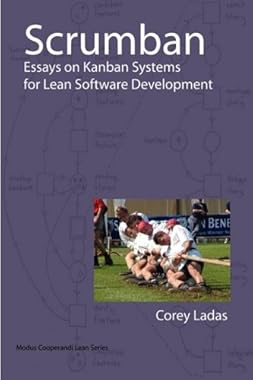
My guess is that Ladas provokes extremes of like or dislike to his writing, depending on whether you happen to agree with him or not. Nevertheless I fall in the middle (well three and half stars rounded up perhaps!) as, while I do find the uncompromising ridicule of non-lean/less-lean processes somewhat wearing, I do think he's got some important ideas to share.

So I'm with the author on the main thrust of his argument, but just to dismiss eXtreme Programming for example as a reinterpretation of the V-model, seems less than just for one of the key advancing influences for agile in the first decade of this century. Similarly Scrum comes in for some merciless treatment - many people are going hate this book on an emotional level long before they parse the content - and especially if they interpreted the title as a description of an agile method that combines elements of Scrum and Kanban. That's not what Ladas means by Scrumban. He's discussing instead what evolution of process would take place if a team was using Scrum and adopted Kanban, while relaxing Scrum's rule-immutability. His answer is that many of Scrum's practices will change and you will end up with a much leaner process, with less work-in-progress, and independent cadences for queue replenishment, improvement events and releases. In other words you end up with a typical Kanban system. Hmmm... take care what you assume is in this book when you read the title!

Any way if you can get past his style, Ladas gives us some very interesting observations on Lean software development systems. In particular I found the "feature brigade" section fascinating - a discussion of how a Kanban process for software development could be built by analogy to a fire brigade's chain of buckets. The point about such a system is that it is self-levelling, since the point at which the fireman with an empty bucket meets the one with the full bucket is variable, depending on the current rate of working of the two participants. Such self-levelling of Kanban systems, if it can be achieved with simple feedback mechanisms like this, will lead to real advantages as they are scaled.

This is an idea worth persevering with the book for!

Breakout sessions that ensure everyone in the meeting meets everyone else

Lockdown finds us doing more and more in online meetings, whether it's business, training, parties or families. It also finds us spendin...